Thursday, April 1, 2010

Wp-2 Rough Draft 2.0

My hyperlinks and multimedia elements are included on the post below, see Wp-2 Rough Draft 1.0.


Cartoons, in the contemporary sense, are written to provide audiences of varying backgrounds information or ideas through a medium that isn’t of the norm.  The funny pages that are tucked in the back of every Sunday morning paper in circulation are just that:  funny.  Comics, serious or light-hearted, provide cartoonists a way of communicating their points in a humorous manner and not of traditional means.  Furthermore, within our modern day and age, comics have transcended the black and white ink and pages of newspapers and have been apart of the informational superhighway that is the Internet.  Cartoonists now have their own blogs and even websites (with their own merchandise stores naturally included), which provides these artists and their work means of communicating with an even broader audience.

The White Ninja is a character in his own comic strip online and on various social networking sites including Twitter and Facebook.  The comic masterminds behind the project are two gentlemen by the names of Kent Earle and Scott Bevan and their project is apart of an webcomic organization known as Dayfree Press.  Earle and Bevan have done over 1000 White Ninja comic strips and continue to write them to this day.  The White Ninja Attempts Armed Robbery comic (pictured below) attempts to send an appeal to their audience's pathos through humor by depicting contrasting contexts that are juxtaposed within the simplistic typography and caricatures.


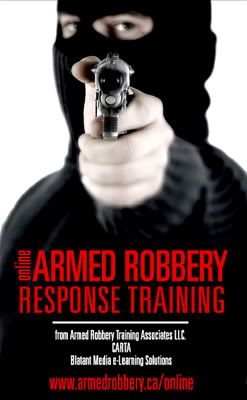
Armed robbery has been prevalent in societies since the dawn of time. The United States has experienced this and indeed had it's dark times from the days of the Wild West and highway robbery to the modern age where Somalian Pirates overthrow naval barge filled with tanks. In the United States, robbery was from colonial days a felony punishable by death. As late as the early 1960s, ten states made some forms of robbery punishable by death (Robbery - The History of Armed Robbery).

The Canadian Armed Robbery Training Manuel is a project and a program in order to educate employees and owners of the severity of dealing with criminals of this sort and have the following statement included in their bio of their website:

"Our trainers…are veteran law enforcement officers with extensive backgrounds in armed robbery investigations. As a result of their investigative experiences they fully understand the issues surrounding the victimization caused by armed robbery as well as what motivates such individuals to commit armed robbery" (Online Armed Robbery Training).

This "victimization" they are referring to is the psychological trauma that the criminals inflict upon the innocent and the biography even alludes to the warped motives that justifies such an act. Such events and concepts carry along with them contexts and connotations furthered by pop-culture and glamorization of such actions in multiple movies of our times.  Such contexts include appeals to pathos through fear and strong-arm tactics in order to command their victims and further appeals to ethos in the professional manner thieves are generally depicted in movies and in the news.  It’s not often that the news reports a robbery going as poorly as the one experienced as the White Ninja’s.  These denotations are in vast contrast with the humor and laughs associated with the standard comic strip and in turn break our expectations. 


The aesthetics of this comic strip are by all means juvenile and appear as if they were drawn by a child. As stated in the Scott McCloud's The Vocabulary of Comics, "But when you enter the world of the cartoon. . . You see yourself". McCloud's book discusses about how he believes that the simplicity and childlike features of comics cause us, as viewers, to relate to said characters. Within "White Ninja Attempts Armed Robbery", the White Ninja and his features are much more simplistic than the Father. This is by no means coincidence and was done in order to cause the viewers to place themselves in the place of the White Ninja. In addition, the panels themselves are no where near perfect squares and appear to be free-handed furthering the simplistic values of the piece as a whole.


Beyond the basic facial characteristics of the White Ninja and the Father, the typography of the panels is just as immature as the characters themselves. The text is short and explicit and is associated to the person speaking it by a line rather than the traditional speech bubble or another mode of comic communication. This form of text allows for emotion through means that offer a further sense of immaturity. The wordplay of the comic is indeed basic and

In the first panel of the comic, the White Ninja is depicted screaming at the Father and showing that he means business. How do we arrive to the conclusion that he is screaming, well the capitalization of all of the words of course. The fact that the White Ninja was seemingly not in control shows both aspects of the piece as a whole. His psychosis, perhaps the trait necessary to be such a criminal, was clearly prevalent but in addition his immaturity shows through thus foreshadowing the foiling of his plot in the scenes to come. Moreover, as we analyze the 5th and 6th frames we notice a repetition as far as the appearance of the panels. The scene shows the Father attempting to disarm the White Ninja, and while in the process, he both realizes that his attacker was never armed and that he had caused him to break wind. While the panels may look similar, this is in fact the turning point for the characterization of the white ninja in which he goes from appearing inexperienced to a more sophomoric appearance.


The events of the comic itself are the last keys that build the hilarity this piece presents. Not only does the audience bring their own connotations associated with robbery, but also the title lends to aid in the appeal. A ninja is often thought of to be stealthy, efficient, and a master of karate. The sheer fact that our White Ninja is attempting to commit robbery with a gun is ridiculous enough and the fact that it is nonetheless a finger-gun makes the scene laughable. The idea that the White Ninja would be ruthless enough to ever be capable of committing such a crime is completely unbelievable. The comic ends with a piece of crude humor that connects back with the childish like humor that the comic is fueled by.


These elements create a contrast between the contexts and emotions usually correlated with armed robbery and the absurdity of such an inept and childish Ninja to be capable of being cynical enough to rob anyone, let alone a father with three children. The "White Ninja Attempts Armed Robbery" comic appeals to its audience's pathos via humor by presenting a juvenile ninja in a primitive scene attempting to carry out a ruthless crime that furthermore closes with crude comedy. Comics are created for various purposes, whether it's to shed light on a political situation overseas or just a simple fart joke, in any case, cartoons and comics allow audience members of any age to relate to simplistic values and universally relatable characters.

Monday, March 29, 2010

WP-2 Rough Draft 1.0


Armed robbery has been prevalent in societies since the dawn of time. The United States has experienced this and indeed had it's dark times from the days of the wild west and highway robbery to the modern age where Somalian Pirates overthrow naval barge filled with tanks. In the United States, robbery was from colonial days a felony punishable by death. As late as the early 1960s, ten states made some forms of robbery punishable
by death. The punishment was far from theoretical, as twenty-four persons were executed for robbery offenses between 1930 and 1962 (Robbery - The History of Armed Robbery).

The Canadian Armed Robbery Training Manuel is a project and a program in order to educate employees and owners of the severity of dealing with criminals of this sort and have the following statement included in their bio of their website:

"Our trainers, Todd Moore and Brian Ken
nedy are veteran law enforcement officers with extensive backgrounds in armed robbery investigations. As a result of their investigative experiences they fully understand the issues surrounding the victimization caused by armed robbery as well as what motivates such individuals to commit armed robbery" (Online Armed Robbery Training).

This "victimization" they are referring to is the psychological trauma that the criminals inflict upon the innocent and the biography even alludes to the warped motives that justifies such an act. Such events and concepts carry along wit
h them contexts and connotations furthered by pop-culture and glamorization of such actions in multiple movies of our times. At what point does our vastly desensitized society come to value scenes as serious as these and seek entertainment through them?


The White Ninja is a character in his own comic strip online and on various social networking sites including Twitter and Facebook. The White Ninja Attempts Armed Robbery comic (pictured above) attempts to send an appeal to their audience's pathos through humor by
depicting contrasting contexts that are juxtaposed within the simplistic typography and caricatures.


The aesthetics of this comic strip are by all means juvenile and appear as if they were drawn by a child. As stated in the Scott McCloud's The Vocabulary of Comics, "But when you enter the world of the cartoon. . . You see yourself". McCloud's book discusses about how he believes that the simplicity and childlike features of comics cause us, as viewers, to relate to said characters. Within "White Ninja Attempts Armed Robbery", the White Ninja and his features are much more simplistic than the Father. This is by no means coincidence and was done in order to cause the viewers to place themselves in the place of the White Ninja. In addition, the panels themselves are no where near perfect squares and appear to be free-handed furthering the simplistic values of the piece as a whole.

Beyond the basic facial characteristics of the White Ninja and the Father, the typography of the panels is just as immature as the characters themselves. The text is short and explicit and is associated to the person speaking it by a line rather than the traditional speech bubble or another mode of comic communication. This form of text allows for emotion through means that offer a further sense of immaturity. The wordplay of the comic is indeed basic and

In the first panel of the comic, the White Ninja is depicted screaming at the Father and showing that he means business. How do we arrive to the conclusion that he is screaming, well the capitalization of all of the words of course. The fact that the White Ninja was seemingly not in control shows both aspects of the piece as a whole. His psychosis, perhaps the trait necessary to be such a criminal, was clearly prevalent but in addition his immaturity shows through thus foreshadowing the foiling of his plot in the scenes to come. Moreover, as we analyze the 5th and 6th frames we notice a repetition as far as the appearance of the panels. The scene shows the Father attempting to disarm the White Ninja, and while in the process, he both realizes that his attacker was never armed and that he had caused him to break wind. While the panels may look similar, this is in fact the turning point for the characterization of the white ninja in which he goes from appearing inexperienced to a more sophomoric appearance.


The events of the comic itself are the last keys that build the hilarity this piece presents. Not only does the audience bring their own connotations associated with robbery, but also the title lends to aid in the appeal. A ninja is often thought of to be stealthy, efficient, and a master of karate. The sheer fact that our White Ninja is attempting to commit robbery with a gun is ridiculous enough and the fact that it is nonetheless a finger-gun makes the scene laughable. The idea that the White Ninja would be ruthless enough to ever be capable of committing such a crime is completely unbelievable. The comic ends with a piece of crude humor that connects back with the childish like humor that the comic is fueled by.

These elements create a contrast between the contexts and emotions usually correlated with armed robbery and the absurdity of such an inept and childish Ninja to be capable of being cynical enough to rob anyone, let alone a father with three children. The "White Ninja Attempts Armed Robbery" comic appeals to its audience's pathos via humor by presenting a juvenile ninja in a primitive scene attempting to carry out a ruthless crime that furthermore closes with crude comedy. Comics are created for various purposes, whether it's to shed light on a political situation overseas or just a simple fart joke, in any case, cartoons and comics allow audience members of any age to relate to simplistic values and universally relatable characters.


Works Cited

Bevan, S, and K Earle. “White Ninja.” Comic strip. white ninja comics. Sparrowhaus Design, 2002. Web. 29 Mar. 2010. .

Online Armed Robbery Training. Canadian Armed Robbery Training Associates, n.d. Web. 29 Mar. 2010. .

Robbery - The History of Robbery. Net Industries, 2010. Web. 21 Mar. 2010. .

Sunday, March 21, 2010

WP-2 Blogpost 2


Armed robbery has been prevalent in societies since the dawn of time. The United States has experienced this and indeed had it's dark times from the days of the wild west and highway robbery to the modern age where
Somalian Pirates overthrow naval barge filled with tanks. In the United States, robbery was from colonial days a felony punishable by death. As late as the early 1960s, ten states made some forms of robbery punishable by death. The punishment was far from theoretical, as twenty-four persons were executed for robbery offenses between 1930 and 1962 (Robbery - The History of Robbery).

Armed robbery and the consequences that accompany it, speak multitudes about what type of person must be committing such a punishable action. Some criminals have been called psychotic, some deviant, yet regardless of a title they must be able to justify their actions and in some instances be cold-blooded in their ways. In the White Ninja cartoon depicted in my previous post, White Ninja is seen attempting to rob the man in the button up shirt. As we continue along through the panels, we learn that this man is a father and attempts to appeal to the White Ninja's pathos by explaining how he has to be the one to provide for them. The White Ninja at this time seems to be caught off guard and taken aback, as is evident in his statement "Oh. . . I never thought my victims might have loved ones." It seems our young thief had done little processing of the actions he was taking and the implications that would follow such as depriving a family of their father's hard-earned paycheck. This White Ninja cartoon does more than just throw around the overdone combination of slapstick comedy and a fart joke, it causes us as viewers to reflect on the severity and means of robbery and whether any of us could carry out what the White Ninja was attempting.

As stated in the Scott McCloud's The Vocabulary of Comics, "But when you enter the world of the cartoon. . . You see yourself". McCloud's book talks about how he believes that the simplicity and childlike features of comics cause us, as viewers, to relate to said characters. Within "White Ninja Attempts Armed Robbery", the White Ninja and his features are much more simplistic than the Father. This is by no means coincidence and was done in order to cause the viewers to place themselves in the place of the White Ninja. Would any of you be able to resist the seemingly sincere plea of the Father in his desperate attempt to save his own life and his family?

The simplicity complex that cartoons employ and provides the core reason that people of all ages can be captivated by them also has an aspect of juvenility. White Ninja also employs such an appeal. At the end of the pictorial, the Father pulls the White Ninja's finger causing him to pass gas. This is indeed childish, yet serves a purpose in the end. This fart effectively affirms the immaturity of the White Ninja as both a thief and a person in general and fills out his character as a whole.

Wednesday, March 10, 2010

WP-2 Blogpost 1


The comic strip that I chose was from the White Ninja comic collection and includes six separate panels. This particular strip is called "White Ninja Performs Armed Robbery" and involves two characters, one being the white ninja (seen masked above) and the second being the man with the distinct facial characteristics. The scene presumably stays constant throughout the whole piece though the audience must infer this because there's nothing in the foreground or background that would indicate any sort of setting. This conscious choice from the artist allows the audience to create the scene for themselves; whether it's a grocery store or in line for the teller at a bank. The scene opens in terror as the white ninja threatens the man with intimidating facial expressions and with what appears to be a gun located under his shirt. As we progress along, we come to find out that the man is a father of three which in fact touches the white ninja on a personal level through an appeal to his pathos. The white ninja, momentarily caught of guard is jumped by the man and seemingly disarmed. The humor of the piece is at the end when the man realizes that the white ninja was indeed never armed and, upon having his finger pulled, just passed gas.

The interactions between both the white ninja and the man (we'll call him the father for convenience) are verbal and are signified by text connected by lines to indicate which character is saying what lines. More powerful than the characters speech are their facial expressions. The mood of the comic is very dynamic in the beginning when the ninja is making demands and feigning a stickup to lighthearted when the father mistakenly attempts to disarm the white ninja thus causing him to rip one. The relationship between the panels is established as a few seconds lapsing within the same conversation between the two characters. Visually this becomes obvious as the characters are in relatively the same places throughout the panels in terms of positioning from one and other.

In terms of aesthetics, the piece is very bland, with only a white background and black lines outlining the characters themselves. Also, it provides an interesting contrast in terms of the construction of the two characters because the white ninja has nothing but his eyes and his mouth to give his face distinct shape and character while the father has a full head of hair, ears, a nose etc.

Overall, the typography of the comic strip gives it the story and backbone that the work requires to accomplish the punchline at the end. There are so few elements to the strip that the focus is completely on the relationship between the characters and the actions happening between the two of them. The typography itself is presented in a simple fashion and seems to be unprofessional and unrefined. The comic's simplicity provides the audience with the option to take everything at play in the various panels into consideration when they're appreciating the piece as a whole.

Sunday, March 7, 2010

WP-1 Final Draft

Author’s Note:

This writing assignment was an interesting project as someone that had minor dealings in photography before. Also, thinking in a rhetorical manner isn’t something that the average person does on a daily basis and this project provided me with a great opportunity to fine tune my analytical skills and work critically. For someone who’s just beginning to take photography seriously, it becomes obvious what elements are fairly easy to control. Some of the more basic photography skills include the framing and cropping of a photo and what the lens is capturing. The framing of a photo is how the photographer can control what they want the audience to see and as Compose Design Advocate states it, “focuses your attentions on parts of a situation”. Framing a photo comes from your placement and angle from your position as a photographer in comparison to the subject matter. Analyzing photography is interesting to me because it’s an art form that anyone can pick up instantly and comprehend to some extent. In the modern-age of technology, anyone can go to the nearest Walgreens and pick up a disposable camera. When viewing photography, it’s important that you separate the argument the photographer was attempting to make and what argument the picture itself is telling you. The aforementioned concept was quite an issue for me and was the reason that I struggled so much when trying to figure out what my argument for my photo was. In photography, sometimes the person with the camera in their hand just gets lucky and takes a photo that touches on ideals that the person themselves never even imagined, but in terms of analytical analysis, you have to interpret the picture which is crucial.

After my initial draft, I felt like the concepts and rhetorical devices I stated for my picture were spot on, but that my ideas were somewhat raw and underdeveloped. One great change that John pointed out to me in peer reviews to consider was the organization of my rhetorical devices. My paragraphs concerning cropping/framing were easily my strongest arguments and I had them buried at the end of my essay rather than at the forefront where they could lead the piece off better. Something that I added between my first and second drafts was located in the paragraphs discussing coloration in that I talked about the contrast in hues of the sailor and the woman’s clothing. It’s actually quite interesting because after John pointed that out to me, I consider the bright hues of the woman’s dress and the uniform of the sailor key aspects when considering the nurturing aura of the girlfriend/wife. Upon receiving input from Josh, I realized that my introduction was in dire need of a few alterations and that I had failed to acknowledge the metaphorical value of the monument. The Tomb, like most gravesites, provides a place for grievance but is ironic to some extent because the living go to worship the dead. All in all, I feel like my essay grew drastically and now that all is said and done I appreciate the writing process a lot and have a lot more confidence in my own abilities to think in a rhetorical manner.

Second Draft

First Draft

Statement of Purpose

Final Draft:


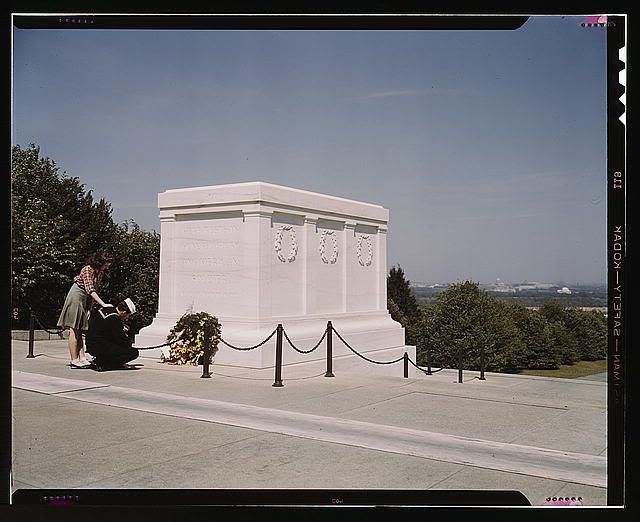
Upon the closure of World War I, the U.S. government hired a special group of photographers to document the events to come under the Farm Security Administration (later under the Office of War Administration during WWII) (American Memory). The photo was taken by John Collier and is known as "Sailor and Girl at Tomb of the Unknown Solider" and whose title barely captures the emotions this picture invokes.

In order to fully appreciate the photograph we also need to analyze its subject matter in its physical place and location in the world and all of the contexts and appeals that these traits carry along. An interesting concept about this photo in comparison to most of the others in this collection by the Farm Security Administration is that this photo is a monument that still stands today whereas many of these other photos cannot be recreated or revisited. This presents another dimension to the subject of the photo, the tomb rather than the people, because we as an audience could physically visit the Tomb of the Unknown Soldier. The photo was taken in 1919 in Washington D.C. at a time in the world when all countries and allegiances were at arms with each other with the transition from WWI into WWII (http://www.tombguard.org/history.html), all of which we have surely learned about in the history books and can try and imagine happening in our lives today but the fact that the monument still stands offers another perspective.


Sailor and the Girl at the Tomb of the Unknown Soldier was taken in order to invoke a sense of patriotism in Americans that were lost and looking for answers after the uncertainty brought on by the Great Depression, but it transformed into something much more. The photograph causes all of us, as a country, to reflect on the costs of war and whether it's worth it or not. These motifs are accomplished through such rhetorical devices such as cropping and/or framing of the photo, coloration, and vectors of attention.

The orientation and framing of this photo is as such that that Capitol Hill is backgrounded behind the row of pine trees that creates the separation between that and the foreground. The foreground is very clear and in focus drawing most of the attention to that while the background is shrouded and hazy in spots making the buildings far off in the distance less distinguishable and thus their elements are subtler. The Tomb, the sailor, and the woman are the three main elements of the photo and our eyes are naturally drawn to them due their clarity and also because of the way the photo is cropped they are several of very few elements in the photograph itself and thus we spend more attention on the specific details they entail.

For instance, the body language and positioning of the sailor and the woman influence us as the audience with appeals to pathos. The knelt position of the sailor gives us the impression that he is mourning or at the very least weakened by the sight of the Tomb and all of the memories it surely represents for him, which causes the audience to sympathize with him and the armed forces that fight for us on a daily basis. The woman, with her hand on the sailor's shoulder, is in a nurturing position and grieving just as much as the sailor but is also there in support for him and his struggles.


The Tomb, being the last key element of the photograph, was shot at such a specific angle and framed in the photo in a way that exemplifies its grandeur and exhibits the shear size of the monument in comparison to its two visitors and the nearby field of pine tree. The monument, though it represents for some the death that naturally follows war, stands tall and could under a different light remind people such as the soldier that those lost are never forgotten. The sailor kneeling down creates the allusion to a temple or shrine as the Tomb, and with this, the audience naturally accepts the Tomb as a place of rememberance
, worship and emotions that can bring even a soldier to tears. The fact that their are only two people and such few elements of attention in the piece speaks to yet another appeal to the emotions and pathos of the picture in that it feels so desolate and isolated where this grave is placed.

The scene is very vivid and lifelike atop the hill of the monument overlooking the city. The vibrant and bold white of the Tomb resonates and immediately grabs our attention due to the contrast of the white marble to the lush green of the nearby pine trees and the sky blue of the horizon. The hue of the white is such that it is the center of attention in the photo and the first thing one notices when they view the piece. An aspect of the photo that is more subtle and may not be noticed during one's first viewing would be the the wreath located at the base of the Tomb which is ironic because the hue of the yellow flowers make them very bright which would normally dominate a photo with so many colors that are so bland yet it doesn't have that affect because of the size of the wreath in comparison the rest of the photo. The colors, while not very bright, are not overly saturated giving the photo a realistic aspect which is crucial as the photo's argument requires viewers to be able to be placed in the scene and time frame. Arlington National Cemetery, like any other graveyard or memorial, provides an interesting moment in time when the living in fact worship the dead. The monument's placement in the shot itself, atop the hill with the clear blue skies in the background, provides a gateway or a vessel for the sailor to go and pay homage to his fallen brothers. The vast background of the vast sky provides the audience an appeal to pathos and the desire for the soldier to be reunited with his comrades that never made it home to their families. The Tomb, which divides the foreground and the background, is the material connection to those sort of intangible feelings and ideas.

Another interesting aspect of the photograph in terms of coloration are the dark, nearly black, hues of both the sailor and the barriers of the tomb. Such dark tones signify mourning or defeat and depict the sailor in a down trot manner and the area as a whole as a place of grievance. Something to consider when taking note of the sailor is that he is dressed in his uniform, which speaks to his emotional connection to both his time served and the tomb before his very eyes. This value is in contrast with the attire of the woman, depicted in a plaid shirt and a skirt, both of which are of lighter colors. The dress of the woman gives the audience the impression that she has more of a carefree attitude and is present in order to support the soldier and brighten his day.

The people present in the photograph are naturally a focus as we, as viewers, seek to relate to those present at the time the picture was taken. With reflection as to how the people must be feeling, and as such it's only natural to start with their vectors of attention. Both the sailor and the woman are turned away from the camera, an aspect that is crucial to our interpretation of the picture because it places the audience in a position of an outsider looking in rather than someone at the scene and there with the couple. This in turn causes the audience to naturally empathize with them as they are simply viewing a picture taken to represent a time period and emotions that accompany it rather than experiencing the hardships themselves.

The fact that their are only two people and such few elements of attention in the piece speaks to yet another appeal to the emotions and pathos of the picture in that it feels so desolate and isolated where this grave is placed. No solider should be forgotten, yet this one was never identified, his family never notified, and his mother left with nothing more than an MIA message from a colonel and chaplain. A monument in his honor, and for the honor of all those that never made it home, built in a field surrounded by pine trees far from the hustle and bustle of Capitol Hill.

The Tomb was built in order to honor the men and women that lay their lives down for our country and embodies all of the sacrifice that this country has been created by through a sense of isolation brought on by expert framing/cropping, contrasting hues and coloration, and simplistic elements in terms of vectors of attention. No solider should be forgotten, yet this one was never identified, his family never notified, and his mother left with nothing more than an MIA message from a colonel and chaplain that never met the man. A monument in his honor, and for the honor of all those that never made it home, built in a field surrounded by pine trees far from the democracy of Capitol Hill.

Works Cited

American Memoryhttp://memory.loc.gov/fsowhome.html>.

McIlvenna, Gavin. History of The Tombhttp://www.tombguard.org/history.html>.