Friday, April 16, 2010

WP-3 Precursory Assignment 4

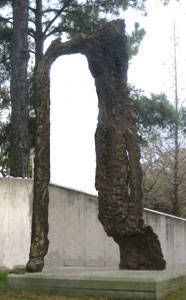
In this the fourth pre-writing assignment for Writing Project 3, the historical and cultural context of the sculpture "Arch Falls", created by Bryan Hunt, will be analyzed.  Hunt is known as a modernist sculptor and focuses many of his works on interpreting nature.  "Arch Falls" is a "gestural" perspective of a waterfall, as if the cascading water and falls were removed from the cliff and river above that create such a natural phenomena.  Aesthetically, the sculpture is made of cast bronze and is a representational form of the falls.


Art objects, and art in general, are devices whose argument speaks differently to each person who views it. As soon as a sculpture is created, it offers itself to the opinions and judgement of the critics.  Furthermore, representational art by definition, needs only characteristics and aspects that would render the piece recognizable.  "Arch Falls" may have the general shape of a waterfall and the textures of of water and rocks, but the fact that the falls stand alone clearly defines that this could never be takes as a photograph.

Art has various meanings dependent upon the culture and the type of art present.  One possible argument or purpose that may be pertinent is that art is a recording or to capture a moment in time.  Art such as "Arch Falls" gives its audience the chance to see the backside of a waterfall, something that would normally never be possible.  The fundamental definition of art is something that causes controversy or discussion due to the complexity of its nature.  From this definition, we can derive that art, especially a representational art object such as this one, has multiple meanings and whose meaning would be impossible for anyone to predict (even the creator).  It is for this reason that Bryan Hunt's "Arch Falls" may have been created for simply an interpretation of a waterfall, but by now has evolved into something much more.  Namely, a chance to view freedom and escape in nature itself.

Wednesday, April 14, 2010

WP-3 Precursory Assignment 3

In my previous Precursory Writing Assignments on "Arch Falls" by Bryan Hunt, I've been focusing on the structural appeals and the more specifically the subject matter of the piece.  Yet, there still lies a multitude of rhetorical elements that have yet to be touched on within all art objects that we have yet to discuss.  Our ultimate goal, comprehension of the sculpture's argument, can only be achieved by analyzing all aspects of a work of art such as this.

One of the finer elements I have yet to key on in my previous post that is one of the more subtle characteristics of this piece is the texture of the falls themselves.  The stern, rigid values of the rocks and the free-flowing, organic nature of the water offer an intriguing representation for the audience.  Though the sculpture stands still and doesn't move at all, the texture of the piece gives us the perception that the falls are doing just that, falling.  This sense of motion that is derived from the textural values of the piece appeal connects the audiences further and allows them a chance to see the structural aspects of a waterfall.  The cultural contexts of waterfalls and offer an appeal to the audience's pathos.  The emotions of water in nature bring about emotions such as freedom and an escape from the stresses of everyday life.

Furthermore, the statue is made of cast bronze, a metal element found in nature.  The bronze was undoubtably chosen because Hunt was aware that this piece would be displayed outdoors and therefore would have to stand up to the harsh realities of Mother nature.  Metals by nature, rust and are corroded by water, yet in this sense the bronze is what makes up the cascading water.  The bronze waterfall offers a still frame of what in nature can never normally be frozen or stopped.  It's for these reasons that "Arch Falls" creates a paradox of the bronze, which is normally destroyed by water, now representing a never-ceasing flow of water, which offers for the audience a chance to bear witness to perspectives of a waterfall that could never normally be seen.
Tuesday, April 13, 2010

WP-3 Precursory Assignment 2


When first viewing the sculpture "Arch Falls", which was created by Bryan Hunt (circa 1980-81), the audience's attention is immediately captivated by the rather large gap located halfway down the front of the object.  This forces the audience to place themselves in the shoes of the sculptor and wonder, just what exactly lies beyond the rushing falls.  The piece as a whole is a rather abstract interpretation of a waterfall, yet by both title and the overall shape of the object we know immediately just what exactly it represents.  The intriguing nature of the void and the simplistic rendering of the falls offers an appeal to the audience's logos but not in the traditional sense.  This sort of higher thinking requires the audience to use deductive reasoning and rationalize the meaning and the argument that the piece creates.  Pablo Picasso once said, "I begin with an idea and then it becomes something else."  Art's purpose is for its viewers to think beyond the object in front of them and to question how certain works make them feel.  The question now is, what does "Arch Falls" make us think about and feel?

The background information on "Arch Falls" may be hard to come by but it is indeed rather interesting.  The piece was actually one of the ones that had been removed from the Sculpture Garden on the east side of Sheldon Art Gallery after being originally installed during the museum's renovations.  The Sheldon Art Gallery's pamphlet concerning the Sculpture Garden itself had this to say of "Arch Falls":  "Hunt is known for “gestural” bronze sculptures, notably waterfalls that convey the ephemeral effects of rippling, fluid surfaces in solid bronze."  The bronze medium gives the piece a professional feel which appeals to the audience's pathos.  At the same time, the sculpture is clearly made by hand, as indicated by the impressions left after the piece's conception, and once again renders itself to the abstract value of the work as a whole.  This creates an interesting paradox in which the art dances the fine line of being both credible visually and yet abstract in nature.  The sculpture is by no means a realist's work, but requires the audience to draw from their personal experience to imagine if these cascading falls where real and they could view them as simply as they do this bronze representation.  The fact that the sculpture is hand made should also further appeal to the audience's pathos because that sort artistic choice calls for the audience to pay particular attention to the emotion of the piece and specifically how they view it.  The bronze tint and textures give the art a mysterious tone.


This being our third writing assignment, I feel both prepared yet interested as to how everything will shake out without doing rhetorical analysis of the work.  Writing this letter will strengthen my analytical and rhetorical skills, but also my writing abilities as a whole.  Overall, Hunt's "Arch Falls" is an abstract representation that appeals to it's audience's pathos through the hand-made value and bronze medium which argues that what lies beyond and in the future should be our ultimate goal.  Well that's my opinion at least, speaking in a rhetorical sense. 

Thursday, April 8, 2010

WP-3 Precursory Assignment 1


My previous experiences with art objects is by all means very minimal and brief.  I've obviously been in art classes that were mandatory in the past and created things such as pottery or paintings but never really found that is was my forte.  My father used to come down and visit me here in Lincoln and he and I would sometimes go visit the Sheldon Art Gallery or at the very least walk around UNL's sculpture garden which we visited last Tuesday.  It's kind of funny that I used to spend nearly one Wednesday of every month at the Garden and I never realized how many sculptures were actually out there.  I guess my only real interest in art was in seventh grade when a couple of friends and I became thoroughly interested in graffiti as an art form.  We transformed my garage into our studio and bought tons of cans of spray paint and went to town.  Unfortunately, that fad passed and I regrettably gave up my once beloved pastime.

Before sitting down and analyzing Arching Falls on Tuesday, my only experience with the art objects around campus this year would only include passing them on my way to class.  I would write them off as more of scenery, as my childhood interpretations rendered them, and never really took time to consider what sort of argument they were actually making.  The most predominant art object on campus would have to be the chrome tree on the bluff to the east of Love North.  This piece is known as Breach and caught my eye as I would walk to class and on my march over to Memorial Stadium for Husker football games.  To say the least, my experiences with art objects, on campus and in life in general, albeit brief, has now left my in a rather interesting position in which I'm excited to see exactly what arguments are being made by these things I've been casually seen in passing.

Tuesday, April 6, 2010

Wp-2 Final Draft

Author’s Note:

When I initially learned that our next writing project would concern rhetorical analysis of comic strips and panels I was skeptical to say the least.  After our first project, I was aware that thinking rhetorically meant that everything present in society makes an argument and more importantly that the piece itself makes that argument regardless of it’s author’s intentions, but I saw little difference between analyzing a photograph with a caption than looking at a comic strip.  To my surprise, I came to find that comics provide a unique medium for ideas to be conveyed to the masses and offer artists a means of communicating largely in part to the simplicity of their work.

Comics are often associated with connotations of either being childish and crude or political and fueled by an agenda of an interest group.  After reading CDA’s comics-specific section and the McCloud essay, I began to understand the advantages of the art form and how they offer different options when making an argument.  Comics are an art form that is often times humorous and this appeal to pathos is something that we can all relate after countless Saturday mornings of our childhood being spent in front of the television set.  In addition, comic strips and characters in the panels are usually depicted as a simplified form of their real-life counterparts.  This offers the artist a chance to exaggerate or to key on the aspects of the character or object that are most important.  These are just a few of the norms comics usually utilize; yet an argument can also be made by breaking such norms.

In my first Writing Project, I made changes to the structure of my points and did minor tweaking to the specifics to each of my supporting elements, but overall I didn’t do global changes from between my initial draft to the final.  In this my Second Writing Project I did just the opposite.  After the peer reviews and rereading my first draft several times I realized that my introduction was drawing away from the topic.  I was attempting to lay out the context of my comic (armed robbery) but overdid it and thus was just confusing my audience.  In my second draft started from a different context, the analysis of comics and how they appeal to their various audiences, and was much more pleased with my work.  Also, I felt like laying out the White Ninja comics line itself was important in order to be able to discuss how since it’s primarily an online comic series it has a larger audience and how the use of technology has advanced comics.

A major structural change I altered between my initial draft and my second draft was how I organized the body of my piece.  In my first draft I broke down the body into sections focusing on the appeals made by the comic (the typography, the characters, the humor) and how they related to the context of armed robbery and thus furthered the argument that by breaking the norms of the context it was humorous.  After reading through the first round of peer reviews I realized that by going out about my argument in this manner wasn’t conducive because it was too confusing for my audience to understand how these elements were effective in breaking these norms.  In my second draft I altered my organization by breaking my body down into two sections:  1) the context and norms of armed robbery in modern society and specifically the emotions associated with the topic 2) the rhetorical elements of the comic and how these were in such contrast that led to the humor of the piece.  By doing this, my essay became clearer in its comparison of the two rather than interlaying the sections and relying on the audience to connect the dots themselves.

Overall, I felt much more confident after revising.  Thank goodness for peer reviews.


Unfortunately I failed to get my Statement of Purpose in on time. So long to those 2 points!


WP-2 Final Draft:


Cartoons, in the contemporary sense, are written to provide audiences of varying backgrounds information or ideas through a medium that isn’t of the norm.  The funny pages that are tucked in the back of every Sunday morning paper in circulation are just that:  funny.  Comics, serious or light-hearted, provide cartoonists a way of communicating their points in a humorous manner and not of traditional means.  Furthermore, within our modern day and age, comics have transcended the black and white ink and pages of newspapers and have been apart of the informational superhighway that is the Internet.  Cartoonists now have their own blogs and even websites (with their own merchandise stores naturally included), which provide these artists and their work means of communicating with an even broader audience.


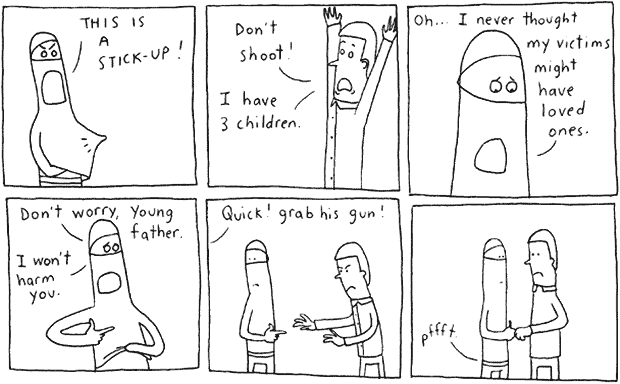
The White Ninja is a character in his own comic strip online and on various social networking sites including Twitter and Facebook.  The comic masterminds behind the project are two gentlemen by the names of Kent Earle and Scott Bevan and their project is apart of a webcomic organization known as Dayfree Press.  Earle and Bevan have done over 1000 White Ninja comic strips and continue to write them to this day.  The White Ninja Attempts Armed Robbery comic (pictured below) attempts to send an appeal to their audience's pathos through humor by depicting the contrasting contexts, crime and humor, which are juxtaposed within the simplistic typography and caricatures.  By appealing to the audience’s pathos in this way, the comic takes on an overall humorous tone.


Armed robbery has been prevalent in societies since the dawn of time. The United States has experienced this and indeed had it's dark times from the days of the Wild West and highway robbery to the modern age where Somalian Pirates overthrow naval barge filled with tanks. In the United States, robbery was from colonial days a felony punishable by death. As late as the early 1960s, ten states made some forms of robbery punishable by death (Robbery - The History of Armed Robbery).

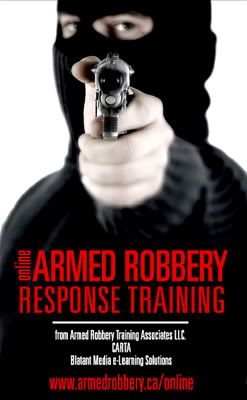
The Canadian Armed Robbery Training Manuel is a project and a program in order to educate employees and owners of the severity of dealing with criminals of this sort and have the following statement included in their bio of their website:

"Our trainers…are veteran law enforcement officers with extensive backgrounds in armed robbery investigations. As a result of their investigative experiences they fully understand the issues surrounding the victimization caused by armed robbery as well as what motivates such individuals to commit armed robbery" (Online Armed Robbery Training).

This "victimization" they are referring to is the psychological trauma that the criminals inflict upon the innocent and the biography even alludes to the warped motives that justifies such an act. Such events and concepts carry along with them contexts and connotations furthered by pop-culture and glamorization of such actions in multiple movies of our times.  Such contexts include appeals to pathos through fear and strong-arm tactics in order to command their victims and further appeals to ethos in the professional manner thieves are generally depicted in movies and in the news.  It’s not often that the news reports a robbery going as poorly as the one experienced as the White Ninja’s.  These denotations are in vast contrast with the humor and laughs associated with the standard comic strip and in turn break our expectations. 


The aesthetics of this comic strip are by all means juvenile and appear as if they were drawn by a child. As stated in the Scott McCloud's The Vocabulary of Comics, "But when you enter the world of the cartoon. . . You see yourself". McCloud's book discusses about how he believes that the simplicity and childlike features of comics cause us, as viewers, to relate to said characters. Within "White Ninja Attempts Armed Robbery", the White Ninja and his features are much more simplistic than the Father. This is by no means coincidence and was done in order to cause the viewers to place themselves in the place of the White Ninja. In addition, the panels themselves are no where near perfect squares and appear to be free-handed furthering the simplistic values of the piece as a whole.

Beyond the basic facial characteristics of the White Ninja and the Father, the typography of the panels is just as immature as the characters themselves. The text is short and explicit and is associated to the person speaking it by a line rather than the traditional speech bubble or another mode of comic communication. This form of text allows for emotion through means that offer a further sense of immaturity. The wordplay of the comic is indeed basic and

In the first panel of the comic, the White Ninja is depicted screaming at the Father and showing that he means business. How do we arrive to the conclusion that he is screaming, well the capitalization of all of the words of course. The fact that the White Ninja was seemingly not in control shows both aspects of the piece as a whole. His psychosis, perhaps the trait necessary to be such a criminal, was clearly prevalent but in addition his immaturity shows through thus foreshadowing the foiling of his plot in the scenes to come. Moreover, as we analyze the 5th and 6th frames we notice a repetition as far as the appearance of the panels.  This atheistic adds to the amateur value of the scene created in the comic and allows for the audience to place the characters in a setting they see fit.  By forcing the audience to create the scene themselves, it makes the characters and comic all that more relatable.  The scene shows the Father attempting to disarm the White Ninja, and while in the process, he both realizes that his attacker was never armed and that he had caused him to break wind. While the panels may look similar, this is in fact the turning point for the characterization of the White Ninja in which he goes from appearing inexperienced or nervous to a more sophomoric in appearance and more of the laughable characters that render comics humorous.

The events of the comic itself are the last keys that build the hilarity this piece presents. Not only does the audience bring their own connotations associated with robbery, but also the title lends to aid in the appeal. A ninja is often thought of to be stealthy, efficient, and a master of karate. The sheer fact that our White Ninja is attempting to commit robbery with a gun is ridiculous enough and the fact that it is nonetheless a finger-gun makes the scene laughable. The idea that the White Ninja would be ruthless enough to ever be capable of committing such a crime is completely unbelievable. The comic ends with a piece of crude humor that connects back with the childish like humor that the comic is fueled by.  A fart joke is by no means a form of higher comedy and thus places the comic in the “slap-stick” humor group of comics that offer laughs at face value.  There are variable levels of humor within the piece, but this is definitely one aspect that is to be taken for what it’s worth, a fart at the end of an already awkward situation.

These elements create a contrast between the contexts and emotions usually correlated with armed robbery and the absurdity of such an inept and childish Ninja to be capable of being cynical enough to rob anyone, let alone a father with three children. The "White Ninja Attempts Armed Robbery" comic appeals to its audience's pathos via humor by presenting a juvenile ninja in a primitive scene attempting to carry out a ruthless crime that furthermore closes with crude comedy. Comics are created for various purposes, whether it's to shed light on a political situation overseas or just a simple fart joke, in any case, cartoons and comics allow audience members of any age to relate to simplistic values and universally relatable characters.


Works Cited:

Bevan, S, and K Earle. “White Ninja.” Comic strip. white ninja comics. Sparrowhaus Design, 2002. Web. 29 Mar. 2010. .


Online Armed Robbery Training. Canadian Armed Robbery Training Associates, n.d. Web. 29 Mar. 2010. .


Robbery - The History of Robbery. Net Industries, 2010. Web. 21 Mar. 2010. .